Life is pretty complicated sometimes, and keeping up with multiple blogs is, well something someone with a full-time marketing career just can't do! But I still want to stay connected.
To make it simpler, the content from this blog is migrating over to www.michellerayburn.com where you'll find occasional posts. If you'd love to see more current posts, Facebook is a great place to stay in touch. Connect with me on my writer/speaker Facebook page.
f

10.16.2016


12.02.2014
When Life Hands You Crumbs...
I saw this basket of cookies at a place called Mana Sushi Teriyaki Wok in Port Orchard, Washington and it made me smile. The "misfortunate" cookies are broken fortune cookies wrapped in plastic.
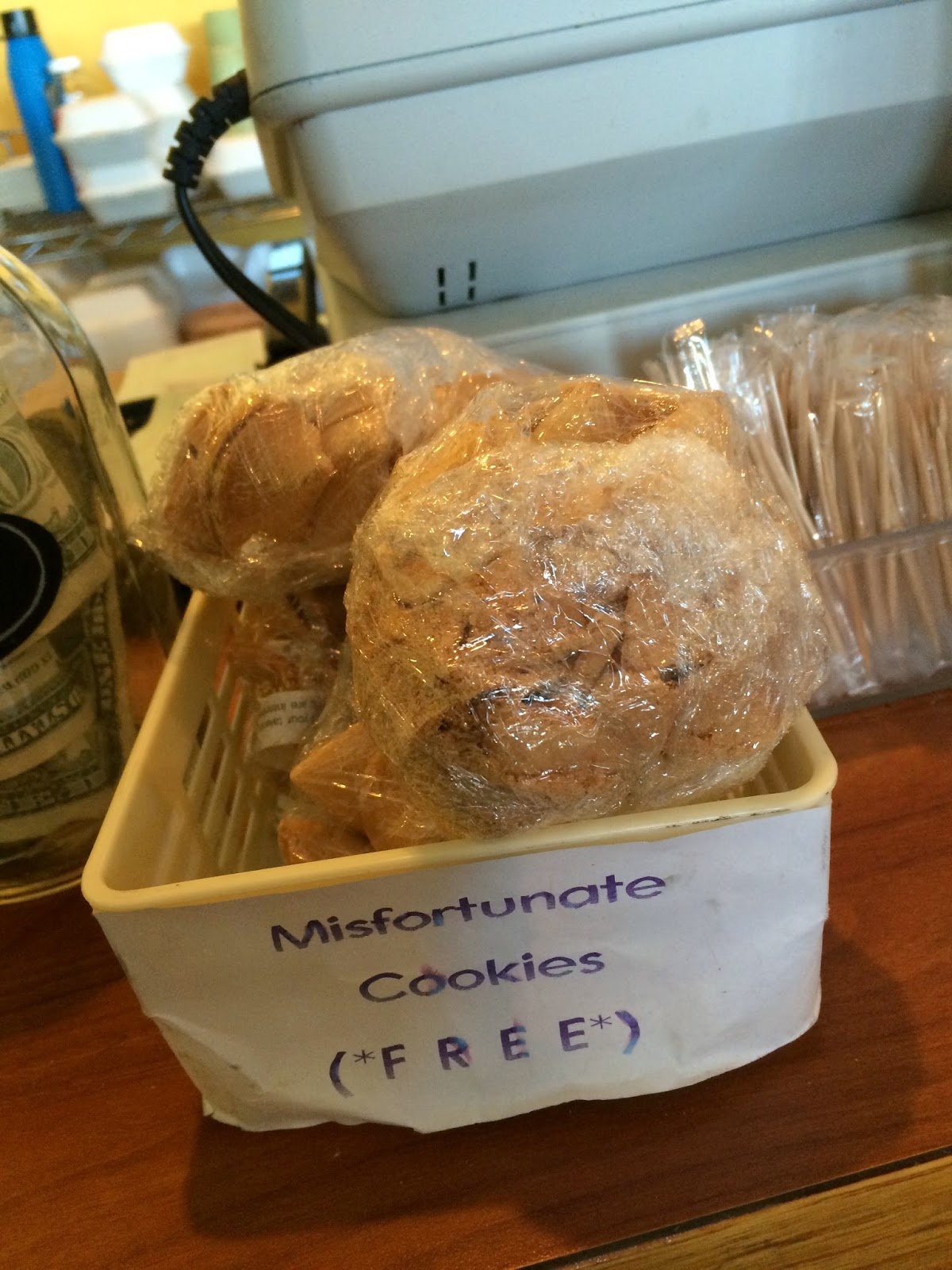
That's a #repurposed and #upcycled life!
12.01.2014
99-Cent Cyber Monday Sale on 'The Repurposed and Upcycled Life'
The Kindle version of The Repurposed and Upcycled Life is on sale on Amazon for Cyber Monday (December 1) for 99 cents.
It's a Countdown sale, meaning the price will increase in increments over the next few days until it returns to the regular price of $5.49.
Click here to download at the sale price


It's a Countdown sale, meaning the price will increase in increments over the next few days until it returns to the regular price of $5.49.
Click here to download at the sale price
11.19.2014
How Many States Have You Visited?
Have you ever calculated how much of the United States you have visited? I just returned from a long road trip, and thought it would be fun to do the math. I'm not certain if I traveled through additional states as a child, but these are the states I have visited as an adult.
Someday, I will visit the East Coast!

Create Your Own Visited States Map
How about you? Where have you traveled?
Someday, I will visit the East Coast!
Create Your Own Visited States Map
How about you? Where have you traveled?
8.28.2014
I'm So Sorry for Your Loss...
Have you ever wondered what to say when someone has just experienced the death of a loved one? I'm not even sure what I would want someone to say to me, but here are some well-worn lines that often come to mind when words elude me:

- I'm holding you in my thoughts and prayers.
- We're praying for you at this time of great sadness.
- I'm so sorry for your loss.

Worn out phrases, but heartfelt, I promise!
That leads me to wonder; just how do the ones left behind express their experience to others? How can they begin to capture and describe the life-changing event?
- My daughter passed away...
- My mother went to be with the Lord after a long battler with cancer...
- I lost my husband last year...
I once heard a well-meaning pastor give his analysis of that last phrase. His response to a widow who used that very expression was, "Oh, did you misplace him? He isn't lost! He has gone on ahead of you, but he isn't lost if he knew Jesus."
He explained how we ought to avoid expressions that refer to death as a loss, and instead we should look for alternatives to express our sympathy.
An attempt at lightheartedness, I guess. No malice intended whatsoever. But...
I've thought about this often. He meant well, but I have to wholeheartedly disagree. After watching several close friends and family go through the painful process of outliving a loved one, I can't think of a better thing to say.
I'm an outsider looking in. So, I could be completely off-kilter with my observations. However, death is a loss. Yes, I have hope knowing the truth of what the Bible says about eternal life. I know exactly where Jesus-followers go after they die. Of course, they aren't misplaced.
But for the ones left behind, it's still a loss.
Death is a loss of communication. It's the end of conversations and tender words.
It's the loss of daily phone calls to mothers and sisters, and friends. Fathers, brothers, and sons.
It's the loss of dishes done side-by-side and glances across steaming coffee cups and warm apple crisp.
It's the loss of mundane banter about weather and politics, newspaper articles, and reality TV shows.
It's the loss of potential resolution for tangled up relationships and harsh words.
It's the loss of possible restitution and redemption. For wrongs to be righted. For restoration.
For many it's the loss of the other half. The part so entwined with our own selves we can't tell where one begins and the other leaves off.
It's the loss of future road trips, laughter, and family reunions.
The absence of knowing smiles.
The loss of plans.
It is a loss.
Let's call it like it is. When someone dies, we suffer a terrible loss. But in the midst of it, we have great hope. And that calm assurance is what makes the loss bearable.
It's what makes it possible to smile even when everything is shaken. When hearts are broken. When we're torn up inside.
In the midst of the great emptiness of loss, there is also great possibility. For it is when we are the most empty we have room for God's love and hope to fill the void.
If you've lost someone dear to you, I can't begin to fully understand. I'm guessing you don't understand it all either. I care. I might not say the right things at all. But please know my heart breaks for you as you discover new losses each day. I'm so sorry for your loss.
6.26.2014
The Christian Chick's Guide to Surviving Divorce
The Christian Chick's Guide to Surviving Divorce:
What your Girlfriends Would Tell You if They Knew What to Say
This is exactly what happened to author Suzanne Reeves. She says she didn’t want “the usual version of surviving divorce—have a glass of wine, slash his tires, head to Jamaica, and party like you did in college. I needed godly advice from a woman who had walked in my shoes and lived to tell about it.”
 Suzanne wants to share hope with other women who are just where she was. She’s lived to tell about it, and she wants to encourage other women going through divorce.
 The Christian Chick’s Guide to Surviving Divorce is the book to give a friend who needs help processing the pain, praising God in the midst of the storm, learning how to forgive, and moving forward. She addresses how to learn from the pain and grow into a better person from the experience of divorce. Instead of bitterness, she urges her readers to be teachable.
 One of the most important topics this book addresses is that of children. Suzanne’s biggest piece of advice is, “You must love your children more than you hate your spouse.” Hurt, anger, bitterness, and sorrow over the betrayal doesn’t need to become the pain of the children as well.
The other important topic this book addresses that many won’t is how to reconcile divorce with being a Christian. Suzanne talks about going to Bible study and asking for prayer, and wondering in her heart if she would have to break her own beliefs about divorce. It wasn’t what she wanted, and she struggled with coming to terms with that loss. This book addresses divorce from a Christian perspective, with solid advice based on what scripture says about God’s love and mercy.

The book also addresses some practical questions that many hope they never have to face. What do you do with the rings? What happens with mutual friends? What happens when ‘your song’ comes on the radio?
The author’s raw honesty, conversational style, and her ability to find humor in her experiences make this book read like a letter from a dear friend who understands. Suzanne has repurposed her own pain into coaching other women through the emotional struggle, shame, and discouragement of divorce to find the courage to move forward.
Disclaimer: I received a copy of the book from the author for my objective review. I also wrote an endorsement for the book.
6.23.2014
All My Belongings: A Book Review
Many Christian authors are off at the International Christian Retail Show (ICRS) this week, hobnobbing with all the names in Christian writing. Which means, it's the perfect 'cat's away, mice will play' opportunity for us to talk about their books, post a bunch of praise on social media, and stir up some new readers for them. Did I lose you at hobnob? Sorry. I love goofy words.
Author Cynthia Ruchti is among those happy ICRS hobnobbers, and I'd love to tell you about her new book, All My Belongings. It's won a couple of awards recently, including a first place Golden Scroll Award from the Christian Author's Network just this week. So, while she's off collecting awards, let me tell you about her book.
Back Cover:
 One phone call destroys all the hope Becca Morrow has for a life beyond the shame of her past. Further discredited by the death of her elderly, ailing patient—the mother of the influential businessman, Isaac Hughes—Becca’s new life is shattered and her longing for love slips away. Working to clear her name, Becca must learn to see the beauty in the ugliness of dying , to accept the tenderness in forgiveness, and—at last—discover that where she belongs isn’t as much about her family history as it is about her faith in the One to whom she’ll always belong.
My Review
All My Belongings is about forgiveness, the longing to belong, the beauty of being loved, and the wonder of godly friendships. But the thread that ties it all together is healing from a painful past. Becca, the main character has suffered from loneliness and rejection embodied by her comment, “Sometimes parents give you away, but they make you stay.” In the midst of loneliness from a painful relationship with her parents, and the fallout of her father’s “occupation” as a Kevorkian-like mercy killer, Becca has found a dear friend, Geneva, who has taken a mother-like role in her life.
As Becca’s friend Geneva helps her change her name, relocate, and find work caring for one of Geneva’s relatives, Becca begins to open up a little about the pain she has experienced. She carries few belongings, but much emotional baggage when she moves across the country to start over. Why the name change? She doesn’t want people to know of her connection to her now imprisoned father, a connection that stands in the way of her desire to become a nurse. Without giving away the plot, I can summarize the rest of the book by saying it’s an adventure in caretaking accompanied by new friendships, a shot at finding love—at last, and some bumps in the road to starting over.
How’s that for summarizing more than 300 pages in a paragraph or two? Speaking of plot, let me tell you what I liked without giving it away. When Geneva meets Geneva’s handsome nephew, Isaac, I had more than a sneaking suspicion of where the book was going, and I thought it odd that the foreshadowing of the ending would be so strong in the first third of the book.
Wrong! Just about the time I had the ending of the book all planned out, an unexpected twist caught me off guard. Halfway through the book, it seemed as if the whole story was wrapping up, but I couldn’t have been more wrong. Again.
A whole new development led to several additional twists that kept me riveted to the plot. And near the end, when I again figured the story was winding down, and additional twist made this stand out from other fiction.
Many stories end with a happily ever after and leave readers with an unrealistic picture of life and relationships. In this book, the author ventures headfirst into confronting the pain of the past, rather than smoothing on some icing and calling it cake. Again, I can’t explain what exactly this means for Becca without giving away the plot, but let’s just say that she learns what real sacrifice and real forgiveness look like.
The realistic solutions to some of life’s nasty problems make this book stand out from other fluffy fiction. There’s nothing fluffy in true forgiveness and sweet freedom from regret. Ruchti engages the reader with a touch of humor and a delightful writing voice. Her unconventional—and not the least bit cliché—descriptions will satisfy the reader who enjoys a more literary style. I highly recommend the book, and Ruchti’s other books.
Author Cynthia Ruchti is among those happy ICRS hobnobbers, and I'd love to tell you about her new book, All My Belongings. It's won a couple of awards recently, including a first place Golden Scroll Award from the Christian Author's Network just this week. So, while she's off collecting awards, let me tell you about her book.
Back Cover:
Where do you turn when changing your name doesn’t give you the anonymity you want? When running hundreds of miles away isn’t far enough? When you search for a place to belong lands you right back where you began?
One phone call destroys all the hope Becca Morrow has for a life beyond the shame of her past. Further discredited by the death of her elderly, ailing patient—the mother of the influential businessman, Isaac Hughes—Becca’s new life is shattered and her longing for love slips away. Working to clear her name, Becca must learn to see the beauty in the ugliness of dying , to accept the tenderness in forgiveness, and—at last—discover that where she belongs isn’t as much about her family history as it is about her faith in the One to whom she’ll always belong.My Review
All My Belongings is about forgiveness, the longing to belong, the beauty of being loved, and the wonder of godly friendships. But the thread that ties it all together is healing from a painful past. Becca, the main character has suffered from loneliness and rejection embodied by her comment, “Sometimes parents give you away, but they make you stay.” In the midst of loneliness from a painful relationship with her parents, and the fallout of her father’s “occupation” as a Kevorkian-like mercy killer, Becca has found a dear friend, Geneva, who has taken a mother-like role in her life.
As Becca’s friend Geneva helps her change her name, relocate, and find work caring for one of Geneva’s relatives, Becca begins to open up a little about the pain she has experienced. She carries few belongings, but much emotional baggage when she moves across the country to start over. Why the name change? She doesn’t want people to know of her connection to her now imprisoned father, a connection that stands in the way of her desire to become a nurse. Without giving away the plot, I can summarize the rest of the book by saying it’s an adventure in caretaking accompanied by new friendships, a shot at finding love—at last, and some bumps in the road to starting over.
How’s that for summarizing more than 300 pages in a paragraph or two? Speaking of plot, let me tell you what I liked without giving it away. When Geneva meets Geneva’s handsome nephew, Isaac, I had more than a sneaking suspicion of where the book was going, and I thought it odd that the foreshadowing of the ending would be so strong in the first third of the book.
Wrong! Just about the time I had the ending of the book all planned out, an unexpected twist caught me off guard. Halfway through the book, it seemed as if the whole story was wrapping up, but I couldn’t have been more wrong. Again.
A whole new development led to several additional twists that kept me riveted to the plot. And near the end, when I again figured the story was winding down, and additional twist made this stand out from other fiction.
Many stories end with a happily ever after and leave readers with an unrealistic picture of life and relationships. In this book, the author ventures headfirst into confronting the pain of the past, rather than smoothing on some icing and calling it cake. Again, I can’t explain what exactly this means for Becca without giving away the plot, but let’s just say that she learns what real sacrifice and real forgiveness look like.
The realistic solutions to some of life’s nasty problems make this book stand out from other fluffy fiction. There’s nothing fluffy in true forgiveness and sweet freedom from regret. Ruchti engages the reader with a touch of humor and a delightful writing voice. Her unconventional—and not the least bit cliché—descriptions will satisfy the reader who enjoys a more literary style. I highly recommend the book, and Ruchti’s other books.

6.12.2014
7 Elements of a Great Nonfiction Book Proposal: A Guest Post from Nick at Grammarly
Today,we have a guest post from Nikolas Baron at Grammarly. Not sure what Grammarly is? Watch for a review post coming soon. In the meantime, if you've ever thought about writing a nonfiction book, you'll find Nick's guest post below helpful.
7 Elements of a Great Nonfiction Book Proposal
Writing a nonfiction book isn’t as simple as sitting down to the typewriter, pounding out two- or three-hundred pages of brilliant work, sending it off to a publisher, and waiting for the checks to start rolling in. In fact, most nonfiction books aren’t written until the idea is sold to a potential publisher. The book is sold on the strength of a book proposal. The book proposal greatly streamlines the writing process, allowing the editor to make any required structural changes early, before the author has invested a great deal of time and effort into the writing.

The book proposal is the author’s opportunity to sell the idea of the book to the publisher. Proper spelling, punctuation, and grammar are critical, as the proposal presents the publisher with not only the idea and details of the potential book, but also a sample of the author’s writing skill. A quality proofreading software should be used to go over the proposal with a fine-toothed comb before submission, to help ensure that the presentation is of the highest quality, increasing the chances of acceptance.
There are as many opinions as to formatting, order, and parts of a book proposal as there are blogs and books on writing, but most agree that there are seven basic elements to the average book proposal. Formatting is generally accepted as double-spaced, in a 12-point classic, easy-to-read font like Times New Roman.
1) The Cover Letter
The cover letter should include a very brief but compelling selling point, also known as a “hook”. The query letter is the writer’s chance to present the editor with the “elevator pitch”. Imagine stepping into an elevator with an editor, and having only a few floors’ ride in which to sell him or her on an idea. There is no need for extensive detail, but a few compelling statistics or other points should be included if applicable.
2) The Title Page
The title page should include a paragraph strengthening the sales pitch, along with an approximate estimated word count of the finished manuscript. The title itself should be brief, informative, and attention-getting. Unique, one- to two-word titles are usually best, depending on the subject matter.
3) Synopsis
The synopsis gives an opportunity to expand upon the subject matter, but should cover no more than two single-spaced pages. This is the author’s opportunity to delve deeper into the subject matter and sell the book based upon the more detailed points.
4) Author Information
The author biography is not a history or resume. The focus needs to be on the sale - this time, the sale of the author themselves. This is the opportunity for the author to highlight expertise, blogging experience, number of followers reached, speaking engagements, or other selling points. Years of experience as an expert in a particular field, consulting work, or a blog which has a solid following and daily unique view counts in the upper thousands are examples of strong points for a bio. Personal experiences that don’t include professional expertise, or plans to blog are irrelevant, unless the personal experience is extremely unique and interesting, or relevant to a wide audience.
5) Market and competition
The writer needs to demonstrate knowledge and familiarity with the audience to reassure the publisher that he or she understands the potential reader. The marketing section should contain research and statistics on the market, as well as a brief synopsis of 3-5 competing titles, with a brief explanation of the differences in the proposed book.
6) Table of Contents and Chapter Outline
This section lays out the blueprints for the book so that the editor can get an idea of how the ideas will be presented and in which order the information will be laid out in the finished book. Each chapter should be represented by a paragraph detailing the major points to be covered.
7) Sample Chapters
Typically, three sample chapters are included with the proposal to give the editor a “taste” of the book and provide proof of concept that the writer is, indeed, capable of producing quality work. Three chapters are usually a sufficient number for the editor to get a feel for the writing.
Bio: Nikolas discovered his love for the written word in Elementary School, where he started spending his afternoons sprawled across the living room floor devouring one Marc Brown children’s novel after the other and writing short stories about daring pirate adventures. After acquiring some experience in various marketing, business development, and hiring roles at internet startups in a few different countries, he decided to re-unite his professional life with his childhood passions by joining Grammarly’s marketing team in San Francisco. He has the pleasure of being tasked with talking to writers, bloggers, teachers, and others about how they use Grammarly’s online proofreading application to improve their writing. His free time is spent biking, traveling, and reading.
4.14.2014
The Turning: a Review of Davis Bunn's Latest Book
Have you ever had a sense you ought to do something, but didn’t know what it meant? Perhaps a pull to go somewhere or say something, but you weren’t sure if you should dismiss it, or listen to it. Was it the voice of God? Or another voice? How do you know?
In The Turning by Davis Bunn, five people from different place in the world come together when they sense a divine command. Once they “randomly” meet up, they realize they have a job to do. At the same time, one individual begins a media campaign to brainwash American young people into believing there is no hope. Together, the five individuals wage war against the forces of darkness to show America that there is still hope. As they obey God’s direction, they see the supernatural continuously at work as God proves that he prevails in their weakness.
I happened to read this book the same week I saw the movie “God’s Not Dead.” Both were powerful reminders that God is still at work.
This book is different from Davis Bunn’s last few books in that there is less thriller action and more supernatural power at work. I enjoyed the book very much. There is plenty of action, but instead of violent physical attacks, the main characters experience more spiritual attack. When they do experience a physical attack, God proves he’s at work.


There were so many themes underlying the story here, but one that I loved was seeing how obedience could lead to restoration. Obedience to God was the very thing that proved there was still hope. When the group listened to him, they saw miracles happen.
The other theme that I loved was a parallel to the story of Moses. God gave him a message, but he had no confidence in his speaking ability. In the book, a character named John is given a big message to share, but he has no confidence in his ability to deliver. Until he surrenders to God. Where naysayers point out his lack of seminary training or speaking experience, God empowers John to carry out the task to which he called him.
The only thing I didn’t like was that I felt like the book left me hanging at the end. Although there was some resolution to the plot, it left me wanting the rest of the story. I won’t spoil it, but something on the very last page tells me the author intended it this way, and I’ll have to wait and see.
Some aspects of the book remind me of the television show “24.” On the show, each episode is one hour of a day, and a whole season of the show is just 24 hours, one day. The whole book spans only 13 days. Chapters a grouped into sections that are subtitled for each day. The pacing of this intensifies the action, and I liked the technique.
All in all, I found the story captivating and relevant to today. I highly recommend it to anyone who likes some mystery and adventure without all the violence and gore of some other genres.
I received a copy of this book from the author’s publicist for review purposes. I was not compensated for my review, nor was I obligated to write a favorable review.
Want to know more about the author, Davis Bunn? Check out his website.
4.07.2014
Blessings...What Does that Really Mean?
How do you sign your e-mails or your letters to people?
 I sign many greetings with "Love, Michelle." That's because much of what I write is to family and close friends. Business correspondence, I sign with "Regards," or "Sincerely." But what about the in-between communication?
Sometimes "love" is too familiar, but "regards" is too stuffy. Then what? Warmly? Maybe. Best? That could work.
Often, I sign my greetings with "Blessings." What does that mean? Do I use it too flippantly, without giving it enough thought? I hope not. To me, it says:
I sign many greetings with "Love, Michelle." That's because much of what I write is to family and close friends. Business correspondence, I sign with "Regards," or "Sincerely." But what about the in-between communication?Sometimes "love" is too familiar, but "regards" is too stuffy. Then what? Warmly? Maybe. Best? That could work.
Often, I sign my greetings with "Blessings." What does that mean? Do I use it too flippantly, without giving it enough thought? I hope not. To me, it says:
- An abundance of peace to you.
- May God bless you with his favor.
- I pray God protects you from harm.
- I wish you much happiness.
- I care about you.
- I hope good things come your way.
Our world is so full of negative words. We hear self-serving words, cutting words, and harsh words on a daily basis. It's on television. It's in the checkout lane. It's around us in conversations we overhear. And it's even in our own written communication and conversations.
In a world of negative, I want to speak something positive. Lord, help me not to take my words lightly. Let my words be full of meaning that would genuinely bless others, and not empty words I toss on a page or in the air.
11.23.2013
The inside scoop from author Davis Bunn on his latest work
Yesterday, I mentioned a new book from author Davis Bunn, Strait of Hormuz. Intrigued? You can read chapters 1-3 of the book for free.
Q and A WITH THE AUTHOR
Q: The first two books in the Marc Royce series have been bestsellers and also won praise from the critics. Lion of Babylon won the Library Journal’s Best Book of 2011 award, and Rare Earth won the 2013 Christy Award for Suspense Fiction. What do you see is behind this success?
Davis Bunn: The stories have certainly resonated with readers. I have tried to develop a strong sense of unfolding drama, combined with a unique spiritual theme. This moral structure plays out both in the story and the characters. My aim is to create an inspirational challenge that remains with the reader long after the book has been set down.
Q: This story includes two special components from your early life. Tell us about them.
DB: My mother worked as an antiques dealer. In truth, ‘work’ was not really the correct term, because this was a passion she inherited from her mother. They bonded while my mom was still a child, going to small eastern Carolina towns and hunting around junk stores for the sort of bargains that don’t exist anymore.
Their first love was early Americana, a type of colonial furniture known as Jacobean that predated America’s nationhood. I never really shared this passion, but in two previous books I came to respect and admire those who do.
And so I knew a great delight in re-entering this world in Strait of Hormuz, only this time at the very highest end. Strait takes place in the rarified world of multi-million dollar art, where the richest of collectors vie with museums and galleries for items that are no longer classed as antiques, but rather as treasures.
The second special component was the location. I lived in Switzerland for almost five years, and many of the venues were places where I worked, and walked, and came to discover myself as an author.
Q: In what way is the setting important to this book?
DB: The Strait of Hormuz is one of the world’s most critical waterways. Stretching between Iran and the Gulf States, the strait us home to two US fleets. More than a third of all the oil consumed worldwide pass through these waters. But the story actually begins in Switzerland, before traveling to the Sinai and then into the hotly-contested Strait of Hormuz.
Q: What spiritual theme is the focus of this story?
DB: One growing area of the missionary church movement is with displaced persons. More than five million Iranians have been expelled from their homeland, or been forced to flee the current regime. This includes virtually the entire Christian population. The missionary church movement has made enormous strides in bringing peace to these families and introducing Christ into the world of Muslims fleeing a Muslim government.
Q: What drew you to the missionary church movement as a theme?
DB: I came to faith in a missionary church. I was working as a consultant based in Germany. The year I accepted Christ, the Southern Baptist Mission Board founded a missionary church in Dusseldorf. I attended the church, I grew in the church, I studied under two amazing pastors, and one of them returned to Europe to marry us.
It was also where I learned to write. Two weeks after coming to faith, I felt called to writing. I wrote for nine years and completed seven books before my first was accepted for publication. The church, its members, and the elders all played a critical role in bringing me to where I am now. I am living testimony to the vital role played by the missionary church.
Q: All three of the books in this series have given significant insight into the Muslim world, something critics have picked up on. What experience do you have with this region?
DB: For the four years prior to moving to Germany, I lived and worked in the Middle East. I was the only non-Muslim in the management structure of a family-owned company. They had three major arms: construction equipment, shipping, and pharmaceuticals. I rose to become Marketing Manager of the pharmaceutical division.
One of the requirements of this job was to take instruction in the Koran and Islamic history from an imam who taught at the local university. I think this experience played a major role in my coming to Christ.
Q: How can readers find you on the Internet?
My website and blog are at www.davisbunn.com
Facebook Author Page: facebook.com/davisbunnauthor
Pinterest: http://pinterest.com/davisbunn/ -- check out my “Strait of Hormuz” board at http://www.pinterest.com/davisbunn/strait-of-hormuz/
Twitter: @davisbunn - http://twitter.com/davisbunn
ABOUT THE AUTHOR
 |
| Pictured: Davis Bunn and his wife, Isabella Bunn |
Strait of Hormuz is the series finale of the popular Marc Royce Adventures. Library Journal named Lion of Babylon (Book 1) a “Best Book of 2011.” Rare Earth (Book 2) won the 2013 Christy Award for best suspense novel and was a CBA top 20 best-seller.
11.22.2013
Strait of Hormuz, a Tastefully Written Thriller
Are you looking for adventure?
I have followed fictional character Marc Royce through Iraq and Africa, and now through Switzerland, and in true Davis Bunn style, the journey didn’t disappoint. This just-released third book in the series continues with agent Marc Royce working on a covert mission for the U.S. State Department in Geneva, Switzerland. For readers who haven’t read the first two books, this one, titled Strait of Hormuz, contains enough back story to pick up without feeling lost, but I highly recommend the first two books, simply because it adds to the depth of the characters who reappear in this book.
I’m a fan of Davis Bunn mostly because he has drawn me into a genre that isn’t typically my style. How? He does action, danger, and even violence so tastefully that my mind can fill in the details needed, without having every gory detail painted on the page. This book has its share of mystery, danger, gunfire, and betrayal, which kept a fast pace for readers who like action. It also has a softer, more relational theme, which brought balance to the plot.


There are several threads that don’t seem to connect until near the end of the book. I enjoy that mystery. Royce is on assignment that begins with an explosion in an art gallery, and ends with, well, of course I won’t tell you how it ends. It had plenty of intrigue to keep me hooked all the way to the end. I like how Bunn weaves a faith element into the story line without it feeling pasted in. In this book, I learned something about Messianic believers without it seeming like a history lesson.
There were several aspects of this story that would make it suitable for the big screen, and I’d be thrilled to see that happen. The ongoing action, an attack from a mysterious motorcade, an assassination attempt, a chilling scene where Royce and his team encounter a vessel on the Red Sea, the multilayered relationships of Royce and his team, wondering if any of them was a mole, and much more. It was one of those books that played like a movie as I read.
I love that this and Davis Bunn’s other books have the potential for a broad male and female audience. The trilogy makes a great gift for the reader who likes a tastefully done thriller.
PLOT SYNOPSIS
An under-the-radar phone call from the U.S. State Department puts Marc Royce once again on assignment—ferreting out rumors of a clandestine operation stretching from Asia to the Mideast. At stake is Iran’s threat to blockade the narrow Strait of Hormuz, cutting off vital shipping routes and escalating global tensions beyond the breaking point.
Under the guise of investigating money laundering via high-end art purchases in Europe, Royce finds himself in Switzerland with only sketchy information, no backup, and without a single weapon other than his wits.
His appointment with a gallery owner in Geneva is a dead end--the man is on the floor with a bullet through his chest. But it turns out Royce does have backup. The Mossad has sent someone to keep an eye on this undercover op, which is of more than casual interest to the Israelis. And it's someone Royce knows...
ABOUT THE AUTHOR
Want to know more about the author, Davis Bunn? Check back for tomorrow's post with a question and answer session on how he came to write this book, and more.
SWEEPSTAKES
Click this image to find out how to enter the to win.

I have followed fictional character Marc Royce through Iraq and Africa, and now through Switzerland, and in true Davis Bunn style, the journey didn’t disappoint. This just-released third book in the series continues with agent Marc Royce working on a covert mission for the U.S. State Department in Geneva, Switzerland. For readers who haven’t read the first two books, this one, titled Strait of Hormuz, contains enough back story to pick up without feeling lost, but I highly recommend the first two books, simply because it adds to the depth of the characters who reappear in this book.
I’m a fan of Davis Bunn mostly because he has drawn me into a genre that isn’t typically my style. How? He does action, danger, and even violence so tastefully that my mind can fill in the details needed, without having every gory detail painted on the page. This book has its share of mystery, danger, gunfire, and betrayal, which kept a fast pace for readers who like action. It also has a softer, more relational theme, which brought balance to the plot.
There are several threads that don’t seem to connect until near the end of the book. I enjoy that mystery. Royce is on assignment that begins with an explosion in an art gallery, and ends with, well, of course I won’t tell you how it ends. It had plenty of intrigue to keep me hooked all the way to the end. I like how Bunn weaves a faith element into the story line without it feeling pasted in. In this book, I learned something about Messianic believers without it seeming like a history lesson.
There were several aspects of this story that would make it suitable for the big screen, and I’d be thrilled to see that happen. The ongoing action, an attack from a mysterious motorcade, an assassination attempt, a chilling scene where Royce and his team encounter a vessel on the Red Sea, the multilayered relationships of Royce and his team, wondering if any of them was a mole, and much more. It was one of those books that played like a movie as I read.
I love that this and Davis Bunn’s other books have the potential for a broad male and female audience. The trilogy makes a great gift for the reader who likes a tastefully done thriller.
I received a complimentary copy of Strait of Hormuz from Bethany House Publishers in exchange for my
honest review.
PLOT SYNOPSIS
An under-the-radar phone call from the U.S. State Department puts Marc Royce once again on assignment—ferreting out rumors of a clandestine operation stretching from Asia to the Mideast. At stake is Iran’s threat to blockade the narrow Strait of Hormuz, cutting off vital shipping routes and escalating global tensions beyond the breaking point.
Under the guise of investigating money laundering via high-end art purchases in Europe, Royce finds himself in Switzerland with only sketchy information, no backup, and without a single weapon other than his wits.
His appointment with a gallery owner in Geneva is a dead end--the man is on the floor with a bullet through his chest. But it turns out Royce does have backup. The Mossad has sent someone to keep an eye on this undercover op, which is of more than casual interest to the Israelis. And it's someone Royce knows...
ABOUT THE AUTHOR
Want to know more about the author, Davis Bunn? Check back for tomorrow's post with a question and answer session on how he came to write this book, and more.
SWEEPSTAKES
Click this image to find out how to enter the to win.
11.18.2013
Five things I figured out in Branson, Missouri
This month, I had the opportunity to take a bus ride to Branson, Missouri with the music students from our local high school. It was an opportunity to learn how puffy my feet could get and how stiff my back could become during an all night, all day ride. I learned how to operate my iPad, dig through a backpack, eat a snack, pick up a dropped cell phone from the bus floor, and more while keeping my elbows within my 18-inch allotted space. But, that's not all I figured out during the five-day trip.
1. Despite statements people might give about the American teenager and the lack of manners in the next generation, I sat beside two wonderful gentlemen at one dinner show, and witnessed multiple occasions where teenage boys were polite to me on the trip.
2. The gospel is alive and well in the Bible belt. Up north, we've become accustomed to people saying happy holidays and pretty much avoiding Jesus in public venues at Christmas. Not in Branson. The gospel was given at every Christmas show, and the music was decidedly Jesus-centered.
3. The loss of life on the Titanic stands as a testimony to what excessive faith in human ability can do. Despite its unsinkable promise, the boat went down within two hours of hitting an iceberg. Worse, the number of lifeboats in proportion to the number of passengers was underwhelming. A reminder to never trust so much in human power that I am irresponsible in my preparation.
4. Never get so preoccupied that you miss the little moments, even if they belong to someone else. As we walked past this little chapel at Silver Dollar City, I noticed a couple saying their wedding vows in the window. The bride wiped away a tear and then reached for her groom's hand. A moment of joy borrowed from people I'll never meet.
5. Always notice the beauty around you, even if terror looms in the foreground. No, I did not ride this terrifying monster. Instead, I looked past it to God's artwork in the sky.
I won't forget my trip. I left Missouri sleep-deprived and over-nourished. But I figured out that there is good everywhere if you look for it.
1. Despite statements people might give about the American teenager and the lack of manners in the next generation, I sat beside two wonderful gentlemen at one dinner show, and witnessed multiple occasions where teenage boys were polite to me on the trip.
 |
| On the Showboat Branson Belle for a lunch cruise. |
 |
| The Haygoods family in concert during the Christmas portion of the show. |
 |
| The Titanic museum in Branson. |
 |
| Silver Dollar City, Theme Park |
5. Always notice the beauty around you, even if terror looms in the foreground. No, I did not ride this terrifying monster. Instead, I looked past it to God's artwork in the sky.
 |
| Silver Dollar City |
10.16.2013
What happens when life doesn't go the way you expected?

So many of the blog posts I see on the internet beautifully demonstrate a repurposed and upcycled life. I had the privilege of meeting an author this summer whose story is a great inspiration for us.
Lee Wolfe Blum (author of Table in the Darkness: A Healing Journey Through and Eating Disorder), posted an excerpt from Welcome to Holland by Emily Perl Kingsley that reminded me of how God repurposes and upcycles in our lives.
What happens when you sign up for Italy and end up in Holland? Lee quotes Kingsley, who says, "But, if you spend your life mourning the fact that you didn’t get to Italy, you may never be free to enjoy the very special, the very lovely things…about Holland."
Lee says, "So, don’t let addiction, comparison, or perfectionism steal any more of the life you were meant to live. Even if it is the life you didn’t imagine, or the struggle you didn’t want to have. Start seeing the tulips and the Rembrandts! It can be beautiful!"
Be sure to read the full post for the rest of the story.


10.14.2013
Finding Treasure in Africa, Amid the Challenges

My friend Kristy has a blog on Babble called Into Africa with Kristy Carlson and her stories are great demonstrations of making the most of a difficult circumstance.
I call Kristy a "friend" rather than an acquaintance because Kristy's husband grew up in my home area, her parents are good friends of mine, and frankly, Kristy has a writing voice that makes me feel close to her. She is raw, and real, and so easy to connect with. Kristy and her husband Ben are living in Africa working to help the people of Burundi get a fair price for their coffee beans and they are building a coffee washing station so more of the crop can processed locally and be sold at the peak of perfection.
Kristy tells the story of an African woman who she met. Kristy says,
There are a million more differences between my story’s and Christine’s, and yet we are both linked by motherhood. Meeting her was a “moment” for me. There is something about who she is and this little family she is holding together that is inspirational and motivational at the same time. Christine is a survivor of genocide, an orphan with courage and a mother with hope. I believe that mothers like Christine can provide more, be more and give more back to their families with just a few more skills under their belts. My friend Samantha believes the same. She is pioneering a program to help Christine provide for her children and I can’t wait to help. It’s a program full of hope and I, for one, am ready to see Christine and her lovely little people out of the animal stocks and living a better life.
 You'll have to hop over to Babble to read Kristy's full story and others. I know you'll be hooked as soon as you see how her stories connect with a repurposed and upcycled life. Kristy has been through many ups and downs in her life in Africa, but she demonstrates how God can use those ups and downs for his glory.
 Kristy considers the circumstances of others when she gets to thinking about her difficulties, and often she sees how her situation isn't as bad as it could be. What difficult circumstance can you recall that didn't seem as difficult when you realized what someone else was going through?
10.12.2013
The Story Our Scars Tell
In an essay from Mary Martin Wiens, she explains how she came to terms with the scars and imperfections on her body,and how she sees them now as lines of a story. Here is an excerpt from Mary's essay. Be sure to hope over to the full post, because the whole article is beautiful.
Read the full postWe journey from a seed in our mother’s womb until we are planted in the grave with ever-changing bodies. Time scratches out its passage across my looks and the looks of all those I love. All our lives, our bodies manifest evidence of an existence marked by gains and losses. We gain and lose pounds, muscle, bruises, teeth, and hair. We lose elasticity and gain wrinkles. We gain scars. Our bodies process and carry our experiences, not without complaint, but with an unfailing perseverance that is worthy of both gratitude and honor. And one of the very great privileges of this life is to cherish the bodies of those I love through all their gains and losses for as long as I get to have them. We do not get to have those we love forever. In that final losing, every turn of the head and expression of the face becomes poignantly precious. So, may I have eyes to see them now.
10.11.2013
Finding Forgiveness for Past Mistakes
This trash to treasure story comes from an anonymous reader. A big hug to a precious woman who was brave enough to be honest with her mistakes and sensitive to the truth that God's love forgives and forgets when we own up to our sins.
Even in our very worst moments, God is there, answering the prayers we haven’t even sent to Him. He knows our every need before we do.
My first husband and I were having marital difficulties even before our second child was born. By the time she was 18 months old there seemed to be little left of our seven year-long marriage. We’d tried counseling, we’d moved to a different state, nothing seemed to help. I could blame the troubles on my husband, but I won’t go there. This story isn’t about his transgressions, it’s about mine.
I don’t know how it happened – well I guess I do know, but I don’t understand how it all spiraled out of control. I started seeing another man, a friend of my husband’s. He was kind and gentle, he listened to me and he didn’t judge me. Most important to me, he didn’t do drugs and he certainly did not deal drugs.
The affair went on for over a year. The lies. I could have drowned in just the lies alone. The lengths I went to to cover those lies. How I held down a full time job, kept house, and raised two children, I will never know. Certainly God wasn’t going to make this easy on me. Yet I kept it up for 13 long months.
At the time, I thought of myself as a Christian. I went to church, took the kids to Sunday School, prayed when I was in need or when I was thankful. I knew there was an omniscient God and that His Son was my Savior. Yet I lived a second life, a life outside of my family and my faith.
I came to a decision. Not the right one, I didn’t want to quit seeing this other man. I wanted to leave my first husband for him. I told myself that we would continue sneaking around until sometime after the divorce was final. Then suddenly we would appear to the outside world as if we had just started going out.
God knew that wasn’t the way this story was going to end, so He stepped in and saved me from myself when I least deserved it.
The night I was going to lay out my plan for this other man, he spoke up first.
“A girl I dated in high school called me up out of the blue. She was my first true love and I had asked her to marry me, but our lives were going in opposite directions. I guess I still love her and I want to see if this can work out for us.”
“What?” I could not comprehend what he was saying. How could he dump me when I had made all these plans?
I drove home alone in a daze. How could this happen to me? What was I going to do?
A gentle voice whispered in my ear. “Even in your darkest moments, I am here.”
How was that possible? How could God see me commit the worst of all sins and still be there for me? How did I deserve that kind of love?
 I spent the next two decades asking daily for God’s forgiveness. The blanket of shame didn’t lift though; I didn’t think it was possible that He could really forgive me. Over time and with lots of prayer, I came to realize that I needed to forgive myself first. I needed to accept that I am a poor miserable sinner but that all of my stains were washed away long ago by the blood of Jesus
Yes, God forgave me. And finally I was able to receive His forgiveness.
Do you have a trash to treasure story to share? See how you can Share Your Story here too.
Subscribe to:
Posts (Atom)
LinkWithin
